Showing posts with label Eroski. Show all posts
Showing posts with label Eroski. Show all posts
Tuesday, October 10, 2006
Today was the second day of my Master's class and we talked for the first art about entrepreneurship and our business plans. For the last four hours of class however we were joined by Antonio Cancelos, Founder of the Eroski (click to see a previous post on Eroski) retail chain and former director of the MCC. He was truly a dynamic and energetic speaker. Cancelos was the head of a local coop grocery store in the town of Eibar (about a half hour away from Mondragón) in the mid sixties he saw the need to join together with other coops in the region to form a larger entity. By 1970 this organization had become Eroski.
As I explained in my previous post on Eroski at a certain point in the 1980´s Eroski underwent a rapid expansion in all of Spain. This was done to head off the arrival of its competitors, such as the French retail chains and perhaps even companies like Wal-Mart. In order to expand they developed Hipermercados (like Supercenters that include food and all kinds of other retail items) and a network of hundreds of smaller stores as well as an alliance with a regional cooperative chain in Valencia called Consum. In order to finance this bold expansion of what had once been two relatively small and regional chains into a national chain capable of competing head-to-head with multinationals, Eroski had to get creative. Aside from forming a partnership with Consum (which fronted only 5% of what Eroski did) they reached out to several investors, limiting themselves to quasi-governmental agencies or non- profits and also the Italian Cooperative chain Coop Italia. With this capital they formed various holding companies and for each individual store the holding group provided 51% of the capital and local partners like ONCE (National Spanish Organization of the Blind) provided the rest of the capital. In this way they were able to multiple their capital to fund the expansion. After a number of years as their new businesses became profitable they were able to fund everything on their own. It also should be noted that they did not recieve money from Caja Laboral.
In the mid-90s Cancelos became the director of MCC, he summarized his six years there in this way: ¨when I arrived there were 28,000 workers in MCC and when I left there were 70,000.¨ He also noted that only about 38,000 of those workers were employee-owners (now days the figure is somewhat higher) and that the rest (that is, non-worker owners) worked abroad or largely at Eroski. He rhetorically raised the question that if the coops were creating non-cooperative jobs at such a large rate would they soon no longer be coops? His answer was that expanding non-coop employment allowed for the creation of more worker owners, made coops more competitive and that during his time as the head of MCC the created on average 2,000 co-operators per year more then during any other period. In addition non-owner workers in MCC companies tend to be treated and paid better then workers in other firms in the same industry.
Meeting Cancelos was even more exciting then meeting Jose María Ormaetxea. He truly embodied the image of an entrepreneur dedicated to cooperativism but open to non-traditional means of growing cooperative firms.


Tuesday, September 26, 2006
Mondragón/Arrasate and Eroski Coop 
Today I went to the birthplace and headquarters of the MCC, Mondragón, or Arrasate as it is known in Basque. Mondragon is a bustling town of at least 30,000. But just like Oñati it is a town that appears much bigger because it is squeezed in a valley (also, there is a huge imposing rocky mountain just outside of town). Consequently, there are a lot of tall buildings narrow streets and a lot of hustle and bustle people in the street in the middle of the day. The middle of town is a picturesque medieval town square. In the main square of Mondragon, on a balcony of the city hall building there was a banner hanging that said a Basque independence slogan and "Zero Pobrezia" or Zero Poverty in Basque. Mondragon, itself is not a poor place. There was a lot of construction, and brand new, fancy apartment buildings and stores. This is clearly a place that is dong well. Nevertheless, the two slogans are about independence and eradicating poverty. That says a lot about the way things are run in Mondragon.
Unfortunately, I didn't spend too much time there or even see any of the industrial coops. I actually went there to go to Eroski, which is Spain's 2nd largest retailer and the largest company in MCC. It is a worker and consumer coop and has about 30,000 workers, only about 12,000 of whom are worker-owners. The chain consists largely of supermarkets, but is increasingly using the Hiper-mercado format which is like the Wal-Mart Super Center. An all-in-one store that has a full service supermarket, clothes, house wares, electronics, a restaurant, cellphone dealer, travel agent, realtor and more stuff, I forget. Affordable stuff, not fancy. Although you have never seen a seafood section like this in a supermarket in the US. All kinds of crazy seafood, eels, unidentifiable stuff. Should have taken a picture.
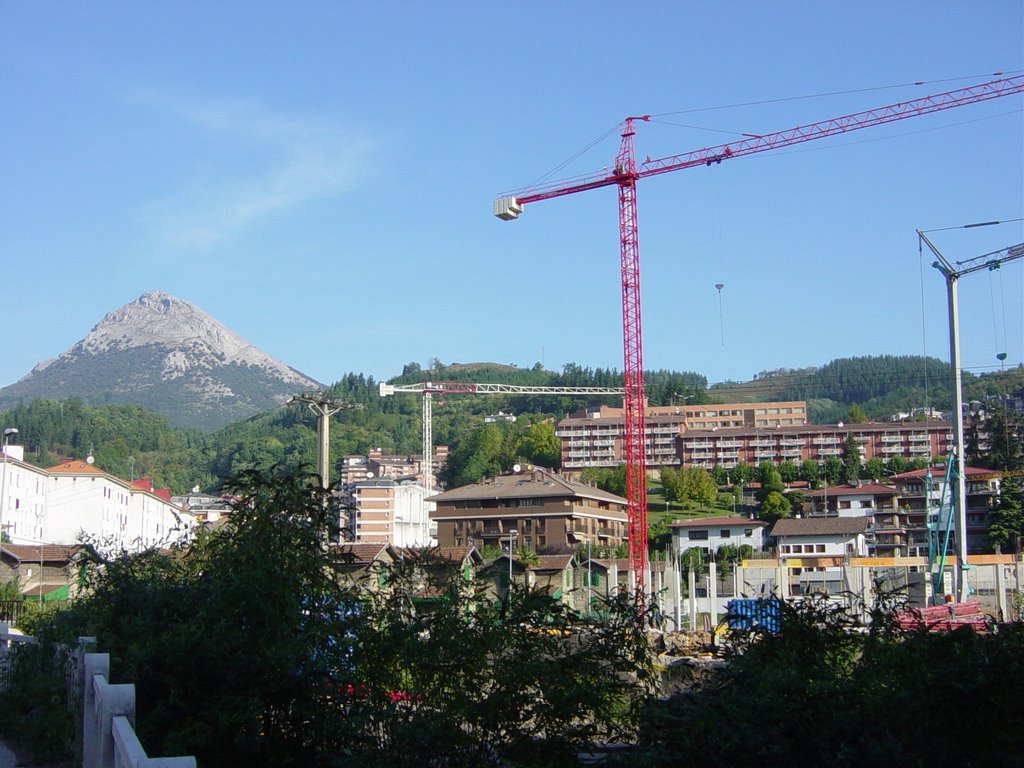
The predominance of non-owner workers (more than 60%) is due to an aggressive and rapid expansion on the part of Eroski to preempt the competition (large retailers like Carrefour from France) and prevent the possibility of companies like Wal-Mart from coming into the country. The strategy is to go head-to-head with these companies and then go about incorporating the workers into an ownership structure. As for my experience at Eroski it was pretty cool. The bus dropped me off downtown and the Hiper-mercado is located on the edge of town so after a 20 minute walk through a light-industrial zone along the river. As you can see from the picture, there are a lot construction cranes. Lots of nice apartments. The store is huge, super clean, super orderly and the workers really nice. It was very much like being in a store in the US, except forthe fish.
As for my experience at Eroski it was pretty cool. The bus dropped me off downtown and the Hiper-mercado is located on the edge of town so after a 20 minute walk through a light-industrial zone along the river. As you can see from the picture, there are a lot construction cranes. Lots of nice apartments. The store is huge, super clean, super orderly and the workers really nice. It was very much like being in a store in the US, except for the fish.
They have also recently announced that all of the brands they sell under the Eroski name will be ranked environmentally. That is, organic products, recycled paper etc. will be labeled and have priority positions on shelves.
I hope to go back to Mondragon soon and give you an update.
Today I went to the birthplace and headquarters of the MCC, Mondragón, or Arrasate as it is known in Basque. Mondragon is a bustling town of at least 30,000. But just like Oñati it is a town that appears much bigger because it is squeezed in a valley (also, there is a huge imposing rocky mountain just outside of town). Consequently, there are a lot of tall buildings narrow streets and a lot of hustle and bustle people in the street in the middle of the day. The middle of town is a picturesque medieval town square. In the main square of Mondragon, on a balcony of the city hall building there was a
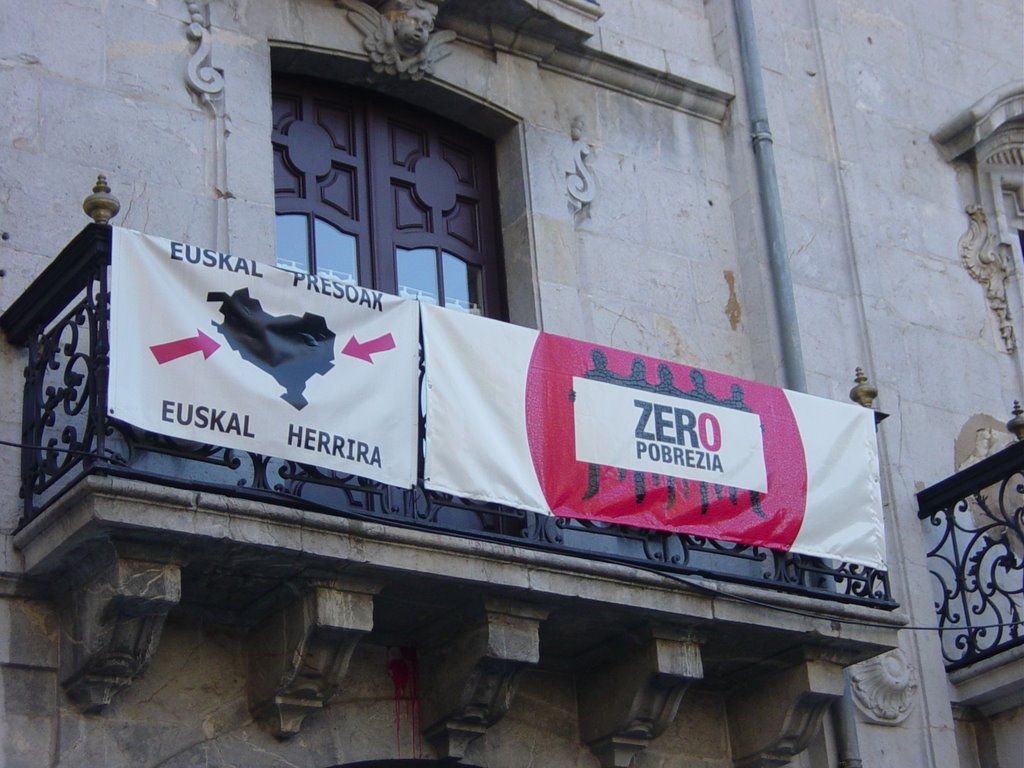 banner hanging that said a Basque independence slogan and "Zero Pobrezia" or Zero Poverty in Basque. Mondragon, itself is not a poor place. There was a lot of construction, and brand new, fancy apartment buildings and stores. This is clearly a place that is dong well. Nevertheless, the two slogans are about independence and eradicating poverty. That says a lot about the way things are run in Mondragon.
Unfortunately, I didn't spend too much time there or even see any of the industrial coops. I actually went there to go to Eroski, which is Spain's 2nd largest retailer and the largest company in MCC. It is a worker and consumer coop and has about 30,000 workers, only about 12,000 of whom are worker-owners. The chain consists largely of supermarkets, but is increasingly using the Hiper-mercado format which is like the Wal-Mart Super Center. An all-in-one store that has a full service supermarket, clothes, house wares, electronics, a restaurant, cellphone dealer, travel agent, realtor and more stuff, I forget. Affordable stuff, not fancy. Although you have never seen a seafood section like this in a supermarket in the US. All kinds of crazy seafood, eels, unidentifiable stuff. Should have taken a picture.
The predominance of non-owner workers (more than 60%) is due to an aggressive and rapid expansion on the part of Eroski to preempt the competition (large retailers like Carrefour from France) and prevent the possibility of companies like Wal-Mart from coming into the country. The strategy is to go head-to-head with these companies and then go about incorporating the workers into an ownership structure. As for my experience at Eroski it was pretty cool. The bus dropped me off downtown and the Hiper-mercado is located on the edge of town so after a 20 minute walk through a light-industrial zone along the river. As you can see from the picture, there are a lot construction cranes. Lots of nice apartments. The store is huge, super clean, super orderly and the workers really nice. It was very much like being in a store in the US, except forthe fish.
As for my experience at Eroski it was pretty cool. The bus dropped me off downtown and the Hiper-mercado is located on the edge of town so after a 20 minute walk through a light-industrial zone along the river. As you can see from the picture, there are a lot construction cranes. Lots of nice apartments. The store is huge, super clean, super orderly and the workers really nice. It was very much like being in a store in the US, except for the fish.
They have also recently announced that all of the brands they sell under the Eroski name will be ranked environmentally. That is, organic products, recycled paper etc. will be labeled and have priority positions on shelves.
I hope to go back to Mondragon soon and give you an update.
Subscribe to:
Posts (Atom)