Long time no see!!!
I am back in Euskadi finally. Well actually I have been for almost a months. But I have been getting a little lazy I must admit. But I am trying to turn over a new leaf I swear.
Want to start off with a quick up date and an interesting paper:
First of all I am back living in Onati, but instead of taking and am doing an internship at Ideko Technology Center which is the technology center that is owned by the companies of the Danobat group of MCC. Danobat is a Machine Tool group made up of 8 companies, a tech center (Ideko) and three foreign subsidiaries. I will provide a more detailed entry on Ideko and the group tomorrow. I have a previous post on Danobat already available. Quickly I want to explain what I am doing. I am working the Product development part of Ideko, which is the non-technical side. I am specifically in the Competitive Intelligence area, which is a whole system of information on the sector, technology, laws, patents, competitors of the companies that own Ideko with the goal of improving the products of Ideko, as well as helping in the launching of new products and in strategic decision making. I am researching cutting edge methods of carrying out CI for Ideko.
I am going to give the link for an article on the internationalization of MCC. It was written by Jose Mari Luzarraga, Ignacio Irizar and Dionisio Aranzadi Telleria. It was presented by Jose Mari at the CIRIEC conference in Victoria Canada. Jose Mari is the premier expert on the internationalization of MCC, he has visited EVERY subsidiary in China, Turkey, India, Poland, Mexico and Brazil and has investigated the impact of the subsidiaries on the cooperatives.
Here is the abstract:
The stability of local communities is threatened by globalization and the international industrial migration process. This article explores Mondragon’s international multilocalization strategy as an effective strategy to avoid de-localization and defend parent cooperatives employment while creating new jobs in developing countries. At the end of 2006, the Mondragon Cooperative Corporation (here after MCC) located in the North of Spain, had 25 Globalized Cooperatives with 65 production plants abroad employing 14.601 people.
Based on the Mondragon cooperatives activity between 1996-2006, this paper:
- Measures the relationship of creating employment abroad and defending
employment at home.
- Analyses the impact that having production plants abroad has on the number of
members vs. non members’ evolution in the parent cooperative and in the
company as a whole.
This research includes analysis from 40 production plants in China, India, Mexico,
Brazil and Eastern Europe.
Here is the link: Luzarraga
Showing posts with label Life in Basque Country. Show all posts
Showing posts with label Life in Basque Country. Show all posts
Saturday, October 27, 2007


Tuesday, November 28, 2006
Sorry about the lack of keeping up. I have been a little out of sorts and feeling a bit directionless. This has been due mostly to my lack of being able to find an internship and the lax nature of the Masters program. Class two days a week, zero homework, zero reading. The nature of a Masters program here seems to be about sharpening professional skills for existing professionals, introducing them to new areas, concepts and the latest fads in business. This allows a lot of time for exploring on my own, defining exactly what I want to learn about and who I want to meet. Some of that time has been put to good use, some has not.
Nevertheless, I feel back on track these days and am starting to have a clearer vision of the areas I want to explore, the companies I want to visit, and the skills I want to learn. Recently, I have visited a few factories and met with some interesting people at a number of key organizations related to MCC.
In the next few days I will relate those experience which include: Fagor Negocio de Muebles de Cocina, Otalora (MCC organization in charge of training managers and new staff in coops values), Lanki (MCC organization in charge of studying coops), MCC Headquarters, Geyser-Gastech (a joint venture between Fagor Electrodomésticos and a German company that makes hot water heaters) as well as some in-depth conversations with professors about MCC.
Agur!
Nevertheless, I feel back on track these days and am starting to have a clearer vision of the areas I want to explore, the companies I want to visit, and the skills I want to learn. Recently, I have visited a few factories and met with some interesting people at a number of key organizations related to MCC.
In the next few days I will relate those experience which include: Fagor Negocio de Muebles de Cocina, Otalora (MCC organization in charge of training managers and new staff in coops values), Lanki (MCC organization in charge of studying coops), MCC Headquarters, Geyser-Gastech (a joint venture between Fagor Electrodomésticos and a German company that makes hot water heaters) as well as some in-depth conversations with professors about MCC.
Agur!
Sunday, October 01, 2006
 Here are few more pictures from the Oñati town festival. The last two days a lot more happened. There were thousand of people in town yesterday during the day for what was kind of like an outdoor fair with farm animals, a big all you can drink hard cider fest, food, handy crafts a market with all kinds of apples and traditional music. Also there were a bunch of traditional Basque sporting events like picking up a really heavy ball over and over, picking up an anvil over and over, tossing hay with a pitch fork over a bar, chopping wood and a couple of others ones that I can't really explain. Over all there amount of people out in the streets and taking part in the activities was really amazing.
After everything was over there a pro ETA march of a few hundred people calling for the release of prisoners held by the Spanish government. Most of those taking part were on the young side. It was a strange way to end the whole scene, but I guess illustrative of the political leaning of most folks there.
Friday, September 29, 2006
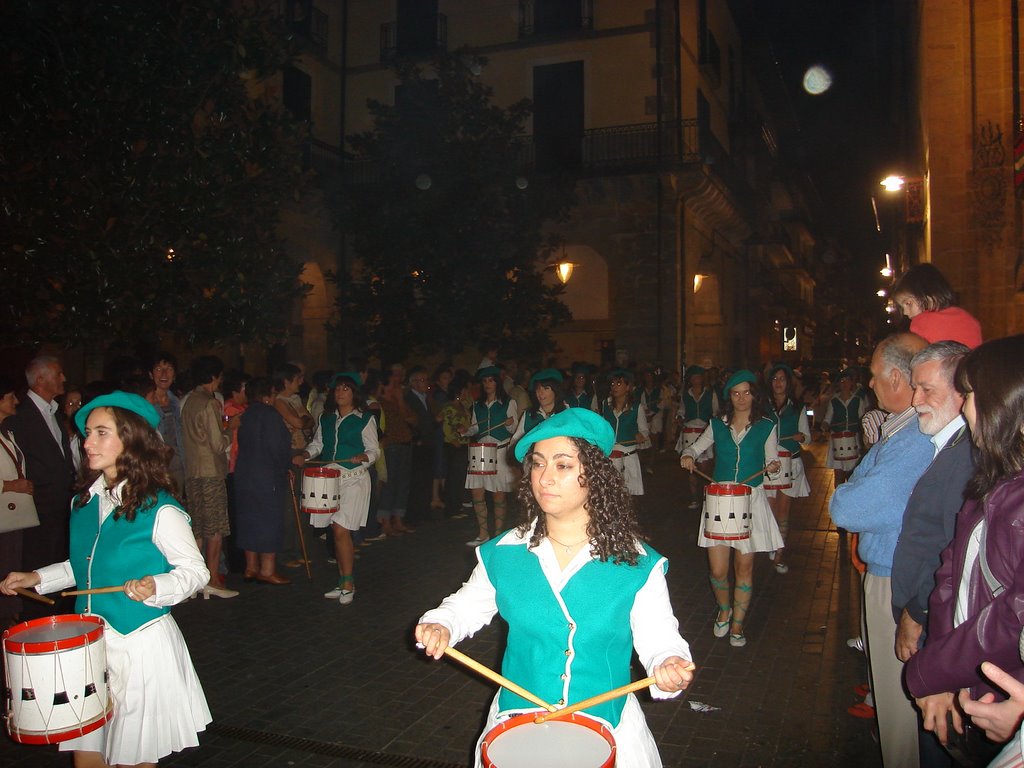 Last night was the first day of the Town Festival for Oñati. It is a pretty wild affair and goes on until Monday, but then Tuesday everything is closed so people can recover from five days of partying. I am not sure what it celebrates, I will have to ask somebody that. But it is quite a big deal, it really seemed like every citizen was out there. In some ways it was reminiscent of a four of July Parade in the
 The unique part is the way people are dressed up, one part of the procession is chefs (presumably a nod to the famous culinary traditions of Basques), while another part is made of people dressed as blacksmiths, (which is because of the long tradition of metal forging, and mining etc in th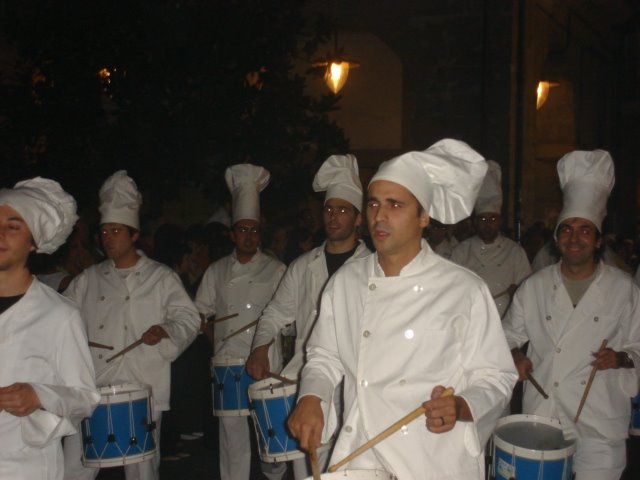 e area) others in traditional Basque peasant clothes. For a small town this is quit a party, all of the bars are packed with people, young and old until at least 4:30 (which is when I went home). People seemed to be pretty voracious drinkers, too (I couldn’t keep up). It was really a lively scene on the street, roving packs of young people go from bar to bar to bar, I think I was 7 or 8 myself. Everywhere was full of people and lots of kid playing and dancing in the plaza to the band (especially early). Will have some more posts for the next few nights.
Tuesday, September 26, 2006
Mondragón/Arrasate and Eroski Coop 
Today I went to the birthplace and headquarters of the MCC, Mondragón, or Arrasate as it is known in Basque. Mondragon is a bustling town of at least 30,000. But just like Oñati it is a town that appears much bigger because it is squeezed in a valley (also, there is a huge imposing rocky mountain just outside of town). Consequently, there are a lot of tall buildings narrow streets and a lot of hustle and bustle people in the street in the middle of the day. The middle of town is a picturesque medieval town square. In the main square of Mondragon, on a balcony of the city hall building there was a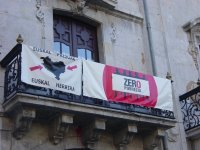 banner hanging that said a Basque independence slogan and "Zero Pobrezia" or Zero Poverty in Basque. Mondragon, itself is not a poor place. There was a lot of construction, and brand new, fancy apartment buildings and stores. This is clearly a place that is dong well. Nevertheless, the two slogans are about independence and eradicating poverty. That says a lot about the way things are run in Mondragon.
Unfortunately, I didn't spend too much time there or even see any of the industrial coops. I actually went there to go to Eroski, which is Spain's 2nd largest retailer and the largest company in MCC. It is a worker and consumer coop and has about 30,000 workers, only about 12,000 of whom are worker-owners. The chain consists largely of supermarkets, but is increasingly using the Hiper-mercado format which is like the Wal-Mart Super Center. An all-in-one store that has a full service supermarket, clothes, house wares, electronics, a restaurant, cellphone dealer, travel agent, realtor and more stuff, I forget. Affordable stuff, not fancy. Although you have never seen a seafood section like this in a supermarket in the US. All kinds of crazy seafood, eels, unidentifiable stuff. Should have taken a picture.
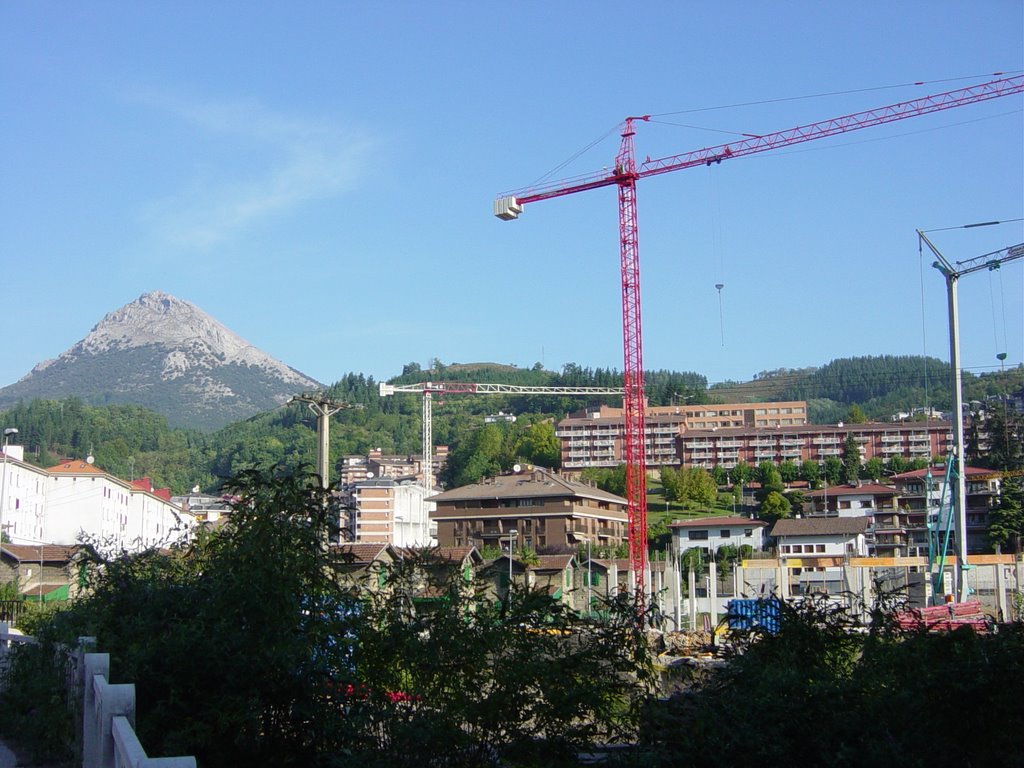
The predominance of non-owner workers (more than 60%) is due to an aggressive and rapid expansion on the part of Eroski to preempt the competition (large retailers like Carrefour from France) and prevent the possibility of companies like Wal-Mart from coming into the country. The strategy is to go head-to-head with these companies and then go about incorporating the workers into an ownership structure. As for my experience at Eroski it was pretty cool. The bus dropped me off downtown and the Hiper-mercado is located on the edge of town so after a 20 minute walk through a light-industrial zone along the river. As you can see from the picture, there are a lot construction cranes. Lots of nice apartments. The store is huge, super clean, super orderly and the workers really nice. It was very much like being in a store in the US, except forthe fish.
As for my experience at Eroski it was pretty cool. The bus dropped me off downtown and the Hiper-mercado is located on the edge of town so after a 20 minute walk through a light-industrial zone along the river. As you can see from the picture, there are a lot construction cranes. Lots of nice apartments. The store is huge, super clean, super orderly and the workers really nice. It was very much like being in a store in the US, except for the fish.
They have also recently announced that all of the brands they sell under the Eroski name will be ranked environmentally. That is, organic products, recycled paper etc. will be labeled and have priority positions on shelves.
I hope to go back to Mondragon soon and give you an update.
Today I went to the birthplace and headquarters of the MCC, Mondragón, or Arrasate as it is known in Basque. Mondragon is a bustling town of at least 30,000. But just like Oñati it is a town that appears much bigger because it is squeezed in a valley (also, there is a huge imposing rocky mountain just outside of town). Consequently, there are a lot of tall buildings narrow streets and a lot of hustle and bustle people in the street in the middle of the day. The middle of town is a picturesque medieval town square. In the main square of Mondragon, on a balcony of the city hall building there was a
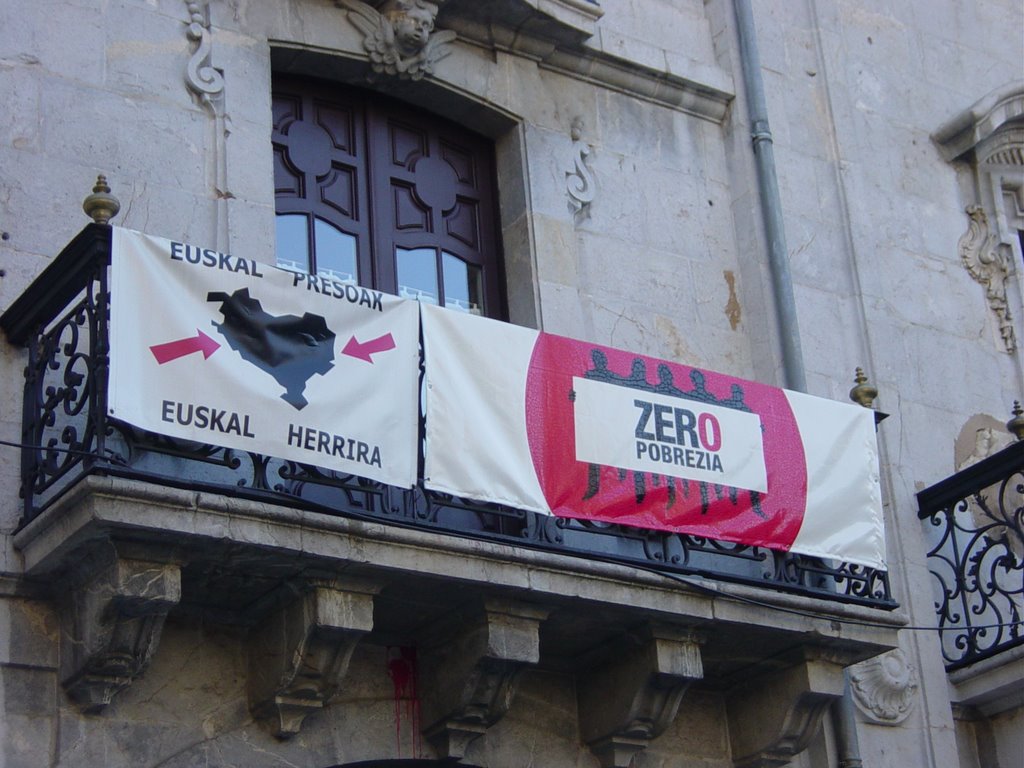 banner hanging that said a Basque independence slogan and "Zero Pobrezia" or Zero Poverty in Basque. Mondragon, itself is not a poor place. There was a lot of construction, and brand new, fancy apartment buildings and stores. This is clearly a place that is dong well. Nevertheless, the two slogans are about independence and eradicating poverty. That says a lot about the way things are run in Mondragon.
Unfortunately, I didn't spend too much time there or even see any of the industrial coops. I actually went there to go to Eroski, which is Spain's 2nd largest retailer and the largest company in MCC. It is a worker and consumer coop and has about 30,000 workers, only about 12,000 of whom are worker-owners. The chain consists largely of supermarkets, but is increasingly using the Hiper-mercado format which is like the Wal-Mart Super Center. An all-in-one store that has a full service supermarket, clothes, house wares, electronics, a restaurant, cellphone dealer, travel agent, realtor and more stuff, I forget. Affordable stuff, not fancy. Although you have never seen a seafood section like this in a supermarket in the US. All kinds of crazy seafood, eels, unidentifiable stuff. Should have taken a picture.
The predominance of non-owner workers (more than 60%) is due to an aggressive and rapid expansion on the part of Eroski to preempt the competition (large retailers like Carrefour from France) and prevent the possibility of companies like Wal-Mart from coming into the country. The strategy is to go head-to-head with these companies and then go about incorporating the workers into an ownership structure. As for my experience at Eroski it was pretty cool. The bus dropped me off downtown and the Hiper-mercado is located on the edge of town so after a 20 minute walk through a light-industrial zone along the river. As you can see from the picture, there are a lot construction cranes. Lots of nice apartments. The store is huge, super clean, super orderly and the workers really nice. It was very much like being in a store in the US, except forthe fish.
As for my experience at Eroski it was pretty cool. The bus dropped me off downtown and the Hiper-mercado is located on the edge of town so after a 20 minute walk through a light-industrial zone along the river. As you can see from the picture, there are a lot construction cranes. Lots of nice apartments. The store is huge, super clean, super orderly and the workers really nice. It was very much like being in a store in the US, except for the fish.
They have also recently announced that all of the brands they sell under the Eroski name will be ranked environmentally. That is, organic products, recycled paper etc. will be labeled and have priority positions on shelves.
I hope to go back to Mondragon soon and give you an update.
Wednesday, September 20, 2006
Tuesday, September 19, 2006

Monday, September 18, 2006
I have finally arrived in Basque country. Well, actually I got here on Saturday after a long trip and my bags have yet to arrive, but I made it safe and sound. After a day and a half spent in Guernica at the house of Universitatea Mondargon Professor Fred Freundlich (who has been nice enough to show me around and take me under his wing here) I am now in Oñati. Oñati (or Oñate in spanish) is a small town of less than 10,000 residents near the town of Mondragon (about 7 miles away). It is located in the Alto Deba region of Guipuzcoa, which has traditionally been the heart of the Mondragon Coops. There are number of coops here including the ULMA group. The Business Department of the Universitatea Mondragon is located here, it is known as ETEO. The area is lush, the town tightly packed with apartment buildings that give it an urban-ness that a town of a similar size in the US would lack. Basque is widely spoken and most things in the street are written in Basque. I am still jetlagged and getting my bearings. My bags haven’t arrived and this is my fourth day wearing the same pants. Classes start in two weeks. More soon. DB
Subscribe to:
Posts (Atom)